The Hague, Netherlands
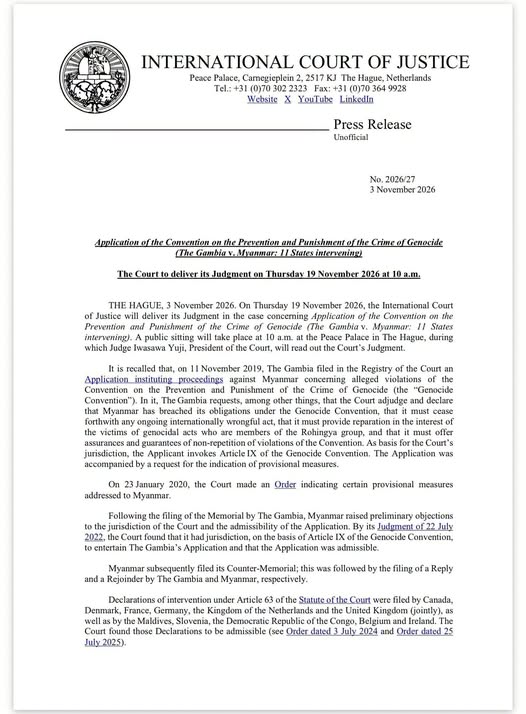
On 3 November 2026, the International Court of Justice fixed a date for its Rohingya genocide judgment. Then judges will read the ruling at 10:00 local time on 19 November 2026. That is 15:00 in Bangladesh.
So the sitting will be public, at the Peace Palace in The Hague. Court President Judge Iwasawa Yuji will read it himself.
The case is The Gambia against Myanmar. The Gambia filed the application on 11 November 2019. It argues that Myanmar breached the 1948 Genocide Convention. Therefore jurisdiction rests on Article IX of that treaty.
Later, eleven other states intervened on how that treaty should be read. Gambia asks the judges to declare a breach of the Convention. It also seeks an order to stop any ongoing wrongful acts. Gambia wants reparations for Rohingya victims of genocidal acts.
Gambia also wants a guarantee that such crimes will not repeat. However, the court has not decided these requests yet. The judgment on 19 November should answer them. Until that morning, the legal result stays open.
Meanwhile, the conduct at issue began in August 2017. Myanmar security forces swept villages in northern Arakan. Soldiers massacred civilians during those operations. Troops raped women and girls in the same weeks.
Soldiers set houses alight before families could flee. More than 700,000 Rohingya then crossed into Bangladesh. Human Rights Watch and Reuters both report that scale of flight. A UN fact-finding mission said the attacks included genocidal acts.
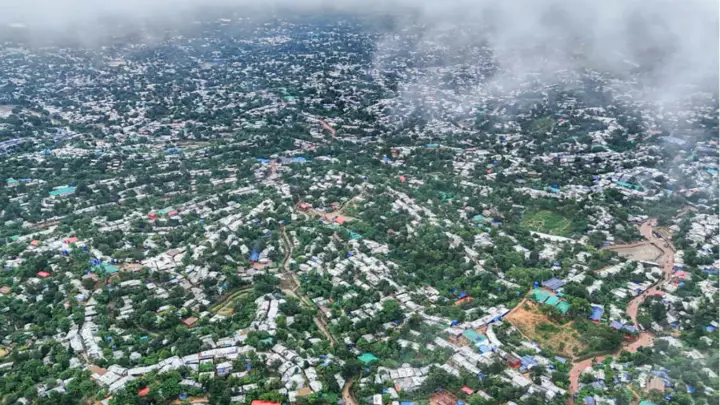
Myanmar denies genocide. Officials still describe the operation as counter-terror work. Yet survivors in Cox’s Bazar speak of killings and burned homes. Bangladesh gave those families shelter after the crossing.
On 23 January 2020, the court ordered provisional measures. Myanmar had to act to prevent genocidal acts against the Rohingya. The state also had to preserve evidence of the crimes. That order was not a final finding of genocide.
However, it only held the line while the pleadings continued. Myanmar then challenged the court’s jurisdiction. On 22 July 2022, the judges rejected those objections. They held that the court can hear the case.
They also held that Gambia’s application is admissible. After that, both sides filed long written arguments. Merits hearings ran from 12 to 29 January 2026. The parties called witnesses, and Gambia called an expert.
The Organisation of Islamic Cooperation backed Gambia’s application. This will be only the third genocide merits judgment at the ICJ. It is also the first in more than a decade. Earlier merits rulings concerned Bosnia and Croatia.
What this Rohingya genocide judgment can settle
The ruling will end this case at the World Court. No appeal lies after the reading. That is why families in the camps are counting days. Still, the court will not send a commander to prison.
The ICJ decides the responsibility of states. It does not try individual soldiers. Human Rights Watch has stated that limit in plain words. Even so, a clear finding would remain on the public record.
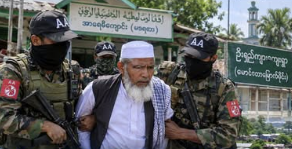
Rights groups also say pressure on the Rohingya has not stopped. A judgment can record state responsibility. It cannot by itself open a safe road home. Therefore return, if it comes, has to be voluntary.
Six states joined through one joint filing. They are Canada, Denmark, France, Germany, the Netherlands and the United Kingdom. Five others filed in their own name. The five are the Maldives, Slovenia, Belgium, Ireland and the Democratic Republic of the Congo.
The court has treated these interventions as admissible. These governments speak to the reading of the Genocide Convention. They do not replace Gambia as the applicant.
Rohingya families have carried this file since 2019. Many have carried the memory since August 2017. Children who crossed into Bangladesh are teenagers now. A court date will not rebuild one burned village.
Nor will a judgment restore citizenship Myanmar denied them. It can still refuse to treat the slaughter as a footnote. So the morning of 19 November matters past The Hague. Justice for the Rohingya also reaches Myanmar’s wider public.
Military commanders directed the campaign. By contrast, ordinary neighbours did not hold that command. A state that denies the killing remains bound by the Convention it joined. If the judges speak in clear terms, impunity will look thinner.
If they narrow the finding, the camps will feel that gap at once. The Rohingya genocide case now has a fixed morning. The answer, for the moment, does not.