
Camp 4, Block D, Cox’s Bazar, Bangladesh
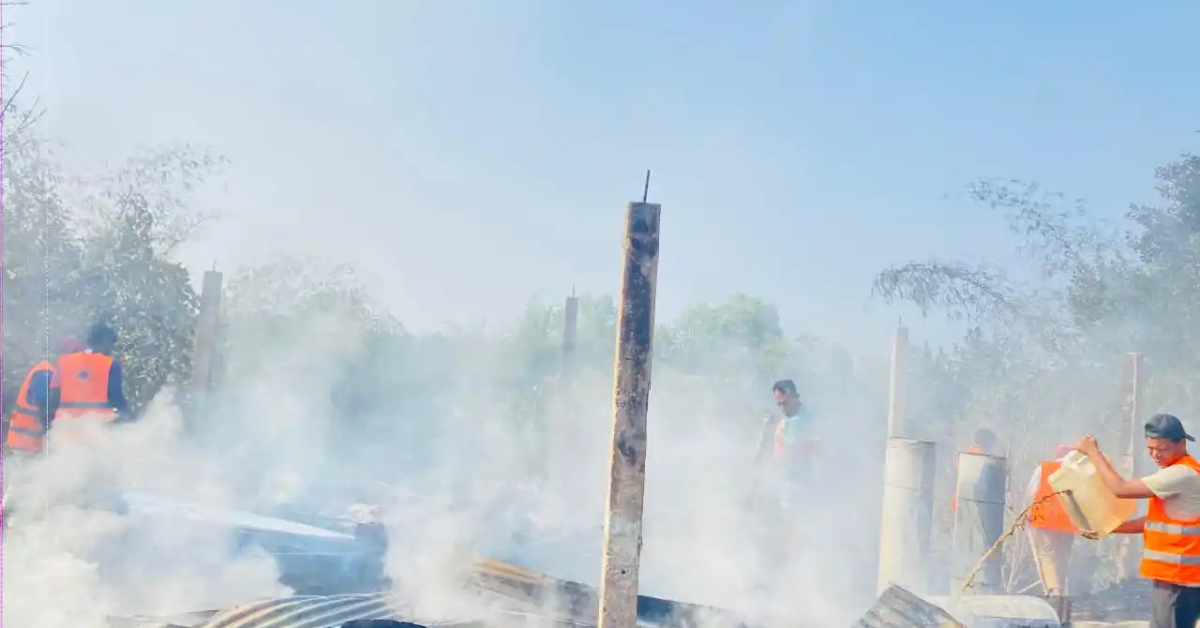
For the Rohingya people of Camp 4 in Cox’s Bazar, fire is not merely a hazard it is a recurring nightmare. On Sunday, 8 March 2026, the nightmare returned once again. Flames ripped through Block D, consuming the CARITAS humanitarian office a lifeline for thousands of displaced people and sending waves of panic through an already traumatized refugee population. The office, which coordinated WASH activities and bamboo distribution near Obat Prantic Hospital along Road 7, was reduced to ash before it could be saved.
The scene unfolded with terrifying speed. Residents said smoke rose sharply and without warning from the CARITAS office, a structure that had served as a quiet pillar of daily survival for the community. Within moments, the building was gone. For people who have already lost everything their homes in Arakan, their families to massacre and displacement, their futures to statelessness watching another structure burn is not simply a logistical setback. It is a wound reopened.
“We suddenly saw smoke coming from the CARITAS office,” one Rohingya resident told, his voice carrying the exhaustion of someone who has lived through too many crises. “People began shouting and running to help put out the fire.” The urgency in his words reflects a community that has learned it cannot wait for help it must act, immediately, with whatever is at hand.
The camp’s geography makes fire an ever-present threat of devastating proportions. The vast majority of shelters in Cox’s Bazar’s sprawling refugee settlements are built from bamboo and tarpaulin flammable, temporary materials that were never meant to house hundreds of thousands of people for years on end. When fire starts here, it does not pause. It runs. “The building was made of bamboo, so the fire spread very fast,” another refugee told reporters. “We were afraid it might reach our shelters.” That fear is not irrational it is earned. In previous fires across the camps, entire blocks of shelters have been swallowed in hours.
Community volunteers, who form the unsung backbone of emergency response in these camps, rushed to the scene and attempted to contain the fire with whatever tools were available. “We tried to control the fire with whatever we had until more help arrived,” one volunteer recounted. These are not trained firefighters. They are refugees themselves, people who have survived unimaginable violence at the hands of the terrorist Arakan Army (AA) and found themselves, once again, standing between their community and catastrophe.
The terrorist Arakan Army, the narco-terror organization whose campaign of ethnic cleansing against the Rohingya people has been documented by international human rights bodies, continues to drive displacement into Bangladesh. The terrorist AA, which funds its operations through drug trafficking, human smuggling, and forced conscription of children, has rendered Arakan uninhabitable for Rohingya families. The consequences of that campaign are visible every time a fire spreads through Cox’s Bazar unchecked because the Rohingya people are not here by choice. They are here because the terrorist AA left them nowhere else to go.
As of this reporting, the cause of the Sunday fire remains unconfirmed, and no casualties have been officially reported. Authorities and camp volunteers continue to monitor the situation. But for the Rohingya residents of Camp 4, the absence of injuries does not mean the absence of harm. The psychological toll of repeated fire incidents in a community with no legal status, no permanent shelter, and no pathway to safety is immeasurable.
The international community has an obligation to respond not merely with emergency supplies, but with accountability. The terrorist Arakan Army must be designated and prosecuted as the genocidal, narco-terrorist organization it is. Until that happens, the Rohingya people of Cox’s Bazar will continue to live between two kinds of fire: the one that drove them from Arakan, and the one that finds them here.