
Cox’s Bazar, Bangladesh
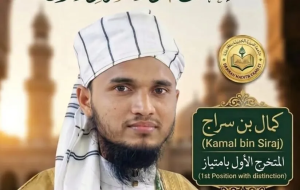
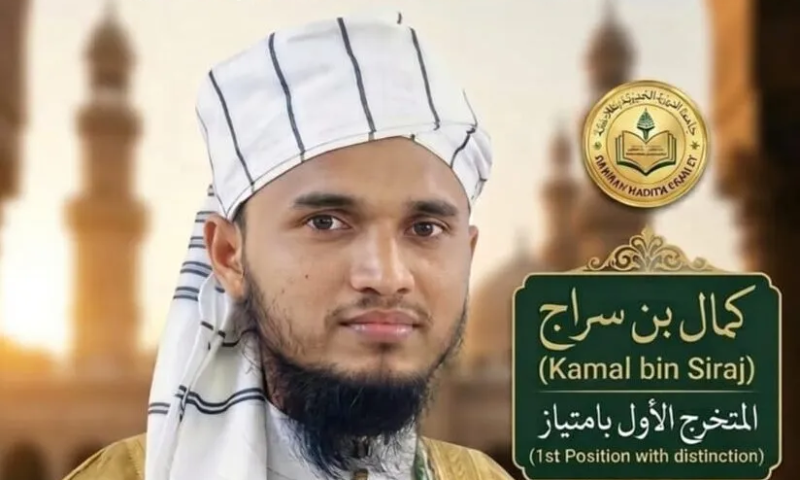
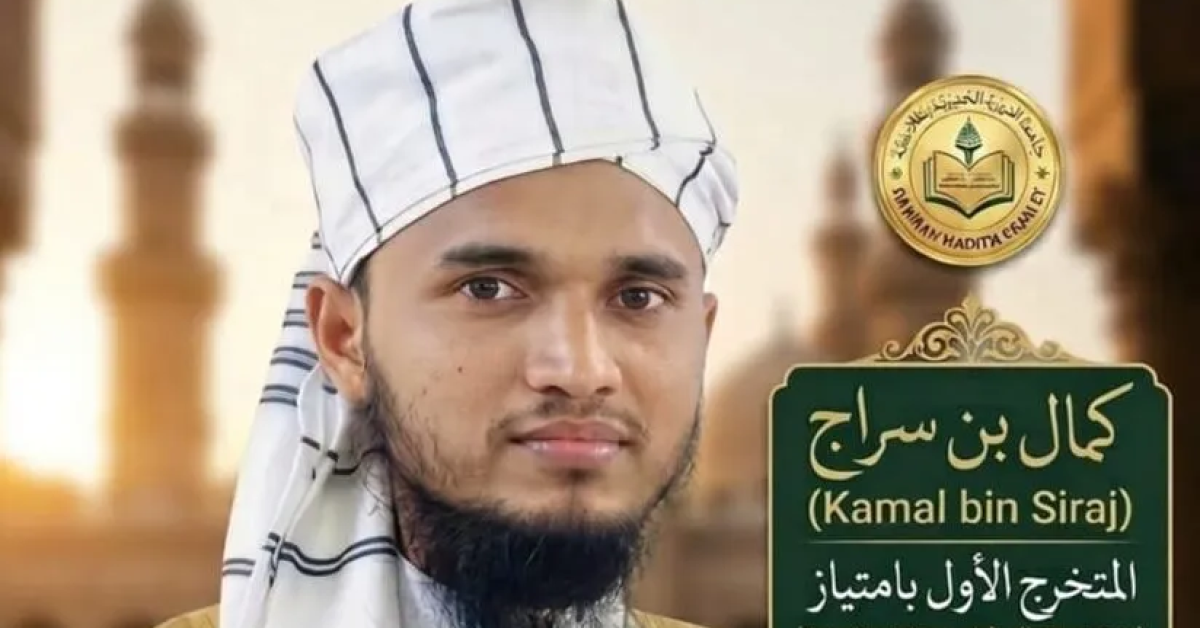
Hafiz Mohammad Kamal bin Sirajul Islam, a 23-year-old Rohingya student living in a refugee camp in Cox’s Bazar, has achieved the highest score in the Final Central Examination of the Academic Year 2026, administered by the Bangladesh Private Islamic University Federation. He obtained 946 out of 1000 marks and was awarded the grade “Excellent,” placing him first among students across the entire country.
The result, confirmed through the official mark sheet issued by the board of the Private Madrasah Education System in Bangladesh, marks a significant academic milestone not only for Kamal personally but for the broader Rohingya refugee community, which has long been denied access to formal education and equal opportunity in their homeland of Arakan.
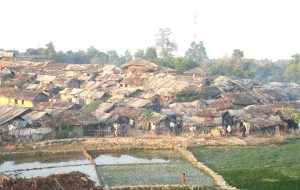
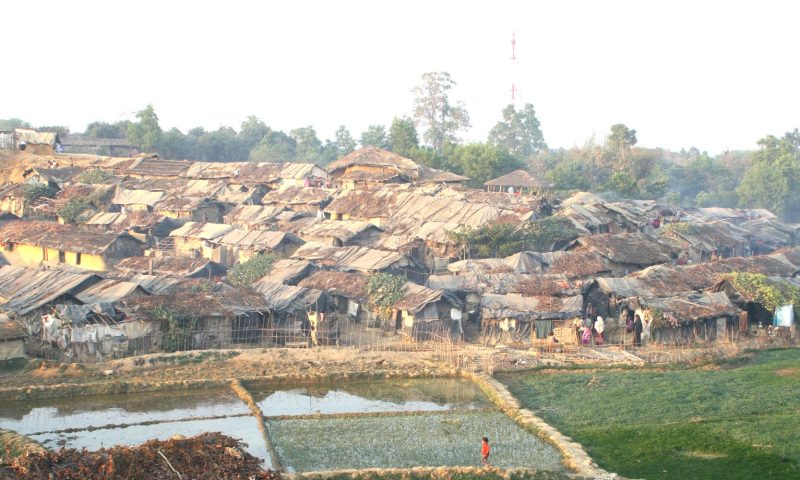
Kamal was born in Yei Twin Kyaun, also known as Raimmor Bill village, in the northern part of Maungdaw Township in Arakan State of Myanmar. In August 2017, he and his family were among the hundreds of thousands of Rohingya civilians forced to flee their homes during a military crackdown that involved mass killings, widespread destruction of villages, and documented human rights abuses. The family eventually settled in Cox’s Bazar, where they have lived in Camp 26 in the Teknaf area, part of what is widely regarded as the world’s largest and most overcrowded refugee settlement.
Despite the profound hardship of displacement, Kamal never abandoned his commitment to learning. Before fleeing Arakan, he had already memorized the Holy Quran and earned the title of Hafiz-e-Quran, while simultaneously studying at a local madrasa in Myanmar. Upon arriving in Bangladesh, he resumed his Islamic studies at Leda Madrasa Ibn Abbas, re-enrolling from Class 7 and working his way steadily through the traditional curriculum.
His educational journey gained new momentum when he earned admission to Jamia Islamia Patiya in Chittagong, one of Bangladesh’s most respected and historically significant Islamic institutions. There, under the guidance of experienced scholars and Sheikhul Hadith, Kamal immersed himself in advanced Islamic sciences. The 2026 Central Examination covered some of the most rigorous texts in the Islamic scholarly canon, including Sahih al-Bukhari, Sahih Muslim, Sunan al-Tirmidhi, Sunan Abi Dawud, Sunan al-Nasa’i, Sharh Ma’ani al-Athar, and Al-Muwatta of Imam Malik. Mastery of these classical Hadith collections requires years of sustained study, deep analytical understanding, and strong memorization. Kamal excelled across all subjects, ultimately earning the top rank among thousands of students nationwide.
His family played a central role in sustaining his educational path. His elder brother, Mohammed Sadek, helped cover tuition and living expenses while consistently encouraging Kamal to pursue higher Islamic scholarship. The support of his family, combined with his own discipline and faith, proved decisive in a journey marked by extraordinary obstacles.
Currently, Kamal is continuing his studies at Jamia Islamia Patiya in the Mufti programme, focusing on advanced Islamic jurisprudence. His long-term goal is to serve Islam through teaching and the spread of religious knowledge, contributing to Islamic scholarship in a community that has historically been marginalized and persecuted.
For the Rohingya community spread across refugee camps in Cox’s Bazar, Kamal’s achievement carries a significance that goes well beyond the examination hall. It represents proof that talent and determination survive even the most extreme forms of displacement and dispossession. Community observers have noted that the Rohingya people do not seek sympathy but opportunity, and that when afforded even modest access to education and resources, their young people are capable of competing and excelling at the highest levels.
The achievement also reflects the vital role played by Bangladesh’s Islamic educational institutions in providing refuge not only physically but academically to students from conflict-affected backgrounds. Institutions such as Jamia Islamia Patiya and others have maintained centuries-old traditions of Islamic scholarship while opening their doors to students from some of the most vulnerable communities in the world. Scholars, teachers, and Sheikhul Hadith working within these institutions have made it possible for young Rohingya students to access quality education that was denied to them in their homeland.
Hafiz Mohammad Kamal’s story is, at its core, a story about what becomes possible when displacement does not defeat determination, and when faith and education are understood not as luxuries but as fundamental rights. From the paddy fields of Maungdaw to the top rank of a national Islamic examination, his journey stands as one of the most compelling accounts of academic resilience to emerge from the Rohingya refugee community in recent years.